

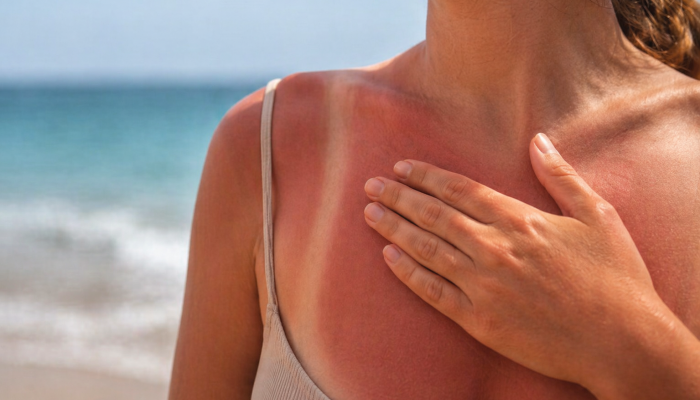
On the island, it’s rare to feel like your skin is “burning.” The sea breeze, comfortable temperatures, and clear skies create a false sense of safety. From an oncodermatology perspective, however, these are exactly the conditions that lead to constant and unnoticed ultraviolet exposure.
Ultraviolet radiation is officially recognized as a carcinogen
According to the World Health Organization and the International Agency for Research on Cancer (IARC), UV radiation is classified as a Group 1 carcinogen. This means it has a proven ability to cause cancer with prolonged exposure.
Skin cancer develops not from a single burn, but from accumulated damage
The real danger is not one intense sunburn, but thousands of micro-injuries the skin receives every day. UVA rays penetrate deeply and weaken the skin’s protective systems over the years. UVB rays directly damage cellular DNA. On the surface, this may look like a “healthy tan,” while mutational processes are already underway beneath.
Living in Cyprus increases the cumulative effect of ultraviolet exposure
The UV index remains high for most of the year. The skin receives radiation not occasionally, but continuously. This chronic exposure is considered one of the key factors in the development of melanoma, basal cell carcinoma, and squamous cell carcinoma.
Fair skin and childhood sunburns multiply the risk
People with fair skin, many moles, and those who were frequently sunburned in childhood belong to a higher-risk group. Children’s skin “remembers” solar damage for decades.
A tan is not a sign of health, but a protective response of the skin
When the skin darkens, it is not getting stronger. It is trying to defend damaged DNA. Preventive recommendations from the European Code Against Cancer clearly state that there is no such thing as a safe tan.
The oncological consequences of sun exposure appear years later
Skin cancer has a long latency period. A person can live for years under active sun without visible issues, and the diagnosis may come much later, when the connection to past habits is no longer obvious.
For tourists, burns are the danger. For residents, it is daily exposure
Tourists often experience acute sunburns. Residents of Cyprus face a more dangerous form of exposure, the chronic accumulation of ultraviolet radiation without obvious symptoms.
Prevention truly works
Limiting sun exposure during peak hours, using SPF regularly even in the city, wearing hats and protective clothing, and having an annual skin check with a dermatologist significantly reduce the risk of skin cancer.
Your behavior in the sun today can influence a diagnosis twenty years from now
The sun in Cyprus is not an enemy, but it is a powerful factor that requires awareness. Daily habits ultimately determine whether a person will fall into a higher-risk group in the future.
https://medhelp24.com/EN/users/amarant-aesthetic-and-health-center