
Every autumn, we see a familiar pattern: after a relatively calm summer, the number of people with runny noses, coughs, sore throats, and fever suddenly increases. Children return to schools and daycare centers, adults begin getting sick more often, and doctors' offices gradually fill with patients suffering from respiratory infections.
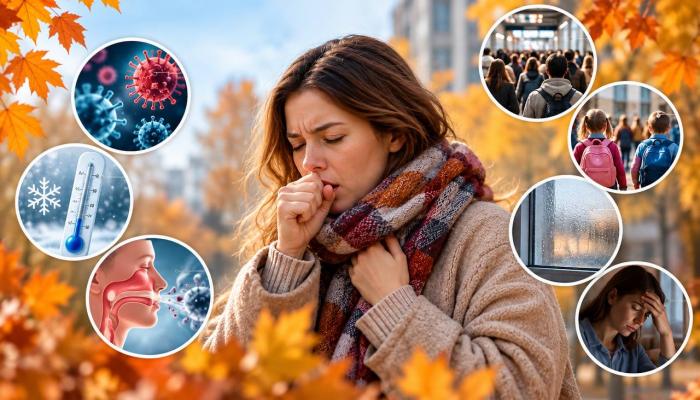
But why does this happen specifically in autumn? It is not simply because the weather becomes colder. The spread of respiratory viruses is influenced by several factors at the same time: air temperature and humidity, the amount of time people spend indoors, ventilation, the seasonality of individual viruses, and the way the respiratory tract's mucous membranes function.
People Start Spending More Time Indoors Again
In summer, we spend considerably more time outdoors. Windows are open, indoor spaces are well ventilated, and interactions between people take place in a variety of settings. As autumn arrives, the situation changes. Children return to schools and daycare centers, adults spend more time in offices, people use public transportation more frequently, and we spend more time in enclosed spaces.
This creates favorable conditions for the transmission of infections through respiratory droplets and aerosols. When an infected person talks, coughs, or sneezes, particles containing the virus are released into the air. In poorly ventilated spaces, these particles can remain suspended in the air for longer and spread between people.
This is why good ventilation is so important in preventing respiratory infections.
Temperature and Humidity Change in Autumn
The environment also matters for many viruses. Research shows that temperature and relative humidity can affect the stability of viral particles and how efficiently they are transmitted. However, different viruses behave differently, so there is no single temperature that is ideal for the transmission of all infections.
The seasonality of influenza has been particularly well studied. In temperate climates, influenza activity generally increases during the colder months of the year. But cold weather does not affect viruses alone.
Cold Air Affects the Respiratory Tract's Defenses
Our respiratory tract has its own defense system. The mucous membranes trap some particles, while tiny hair-like structures called cilia constantly move mucus, together with trapped particles, toward the throat. This mechanism is known as mucociliary clearance.
When a person breathes in cold, dry air, the effectiveness of this system may decrease. The mucous membranes can become more vulnerable, and the natural removal of particles from the respiratory tract may become less efficient. Research suggests that exposure to cold air can reduce the effectiveness of mucociliary clearance and alter local defense mechanisms in the respiratory tract. This does not mean that cold weather itself causes a viral infection. An infectious agent is still required for illness to develop. However, environmental conditions may influence how effectively the body is able to defend itself against it.
Why Is the Autumn Increase Particularly Noticeable Among Children?
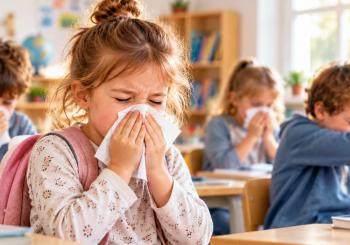
Autumn is something of a “test” for the immune systems of children in group settings. After the holidays, children once again begin having close contact with one another. They spend many hours in the same indoor spaces, share objects, play, talk, and do not always follow good hygiene practices.
In addition, younger children have not yet developed immune experience against many of the viruses they encounter for the first time. As a result, the number of respiratory infections can increase noticeably during the first few months after children return to group settings. A so-called “September peak” in respiratory infections and asthma exacerbations among children is particularly well recognized.
But Viruses Do Not Disappear During Summer
It is important to understand that respiratory viruses do not “appear” in autumn. Many of them circulate throughout the year; their prevalence simply fluctuates seasonally.
For some viruses, the peak occurs during the colder months, while for others, seasonality may be less pronounced or may depend on the specific region. For example, rhinoviruses are one of the most common causes of the common cold. Their activity may increase during transitional seasons. Influenza usually demonstrates more pronounced seasonality. In temperate countries, its main activity occurs during the autumn and winter months.
RSV is particularly important for young children and older adults. Its seasonality is also pronounced, although the exact timing of the beginning and peak of the season may vary depending on the country and the year.
Why Closed Windows Can Make a Difference
As the weather becomes cooler, people tend to ventilate indoor spaces less frequently. When many people are in the same room, the concentration of airborne particles gradually increases. With insufficient ventilation, this can increase the likelihood of transmission of infections that spread through the air.
Therefore, regular ventilation remains one of the simple ways to reduce the concentration of potentially infectious aerosols. This is particularly important in schools, daycare centers, offices, and other places where large numbers of people are present at the same time.
There Is Another Factor: Changes in Daily Routine
Autumn changes more than just the weather. After the summer period, people return to their usual schedules, start getting up earlier, spend more time indoors, and face increased workloads and stress. Lack of sleep and chronic stress can affect immune system function. This does not mean that one sleepless night will necessarily lead to a cold. However, prolonged sleep disruption can indeed increase susceptibility to certain infections.
Therefore, prevention of respiratory infections involves more than simply wearing a mask or washing your hands. Adequate sleep, a balanced diet, physical activity, and a regular daily routine also play a role in maintaining immune defenses.
Why Can One Infection Spread Quickly Through a Group?
One characteristic of many respiratory viruses is that a person can be contagious even before they begin to feel seriously ill. They may go to work or send their child to school, thinking that it is simply mild fatigue or a slight sore throat.
With close contact, the virus can then spread rapidly to others. That is why simple measures are particularly important during the autumn and winter months: staying home when experiencing significant symptoms of an infection, washing hands regularly, ventilating indoor spaces, and avoiding close contact with people at higher risk when you are ill.
Autumn Itself Does Not Make People Sick
Cold weather is not the cause of the common cold or influenza. Viruses are the cause. In autumn, conditions simply become more favorable for many viruses to spread: people spend more time together indoors, temperature and humidity change, some of the respiratory tract's defense mechanisms become less effective, and the seasonal activity of certain viruses increases.
Therefore, prevention is not about “avoiding the cold,” but about reducing the risk of infection and supporting the body's natural defense mechanisms. And if a person gets sick noticeably more often in autumn than in summer, this does not necessarily mean that they have a weak immune system. It is often a natural consequence of the seasonality of infections and the changes in the conditions in which we live and interact.